
Marketing can feel big and confusing. So many terms. So many rules. So many “experts” who make it sound hard.
It’s not hard. Not really.
At its core, marketing is just one thing: helping the right people find your product, and showing them why it helps them.
This guide breaks down marketing fundamentals in plain words. No fluff. No filler. Just the parts that matter, explained the way you’d explain them to a friend.
What Is Marketing, Really?
Marketing is how you tell people about your product or service. It’s how you get them to notice you, trust you, and buy from you.
Good marketing does three things:
- It finds the right people.
- It shows them why your product helps them.
- It makes it easy for them to buy.
That’s it. Everything else builds on this.
The 7 Ps of Marketing
In the past, marketers used four core ideas to plan their work. Over time, three more got added. Today we call this the 7 Ps. Think of them as seven questions you must answer before you sell anything.
| P | The Question It Answers |
|---|---|
| Product | What am I selling? |
| Price | What should it cost? |
| Promotion | How will people hear about it? |
| Place | Where can people buy it? |
| People | Who helps the customer along the way? |
| Process | How smooth is the buying experience? |
| Physical Evidence | What proof shows my brand is real and trusted? |
Let’s look at each one.
Product: What Are You Selling?
Know your product inside and out. What does it do? What problem does it solve? Why is it better than other choices?
You can’t sell what you don’t understand. So start here. List every feature. Then list every benefit. A feature is what it does. A benefit is why that matters to the customer.
Price: What Should It Cost?
Price is not just a number. It’s a message. A high price can say “this is premium.” A low price can say “this is a great deal.”
To set the right price, do three things:
- Check what competitors charge.
- Ask what your buyers can afford.
- Test a few price points if you can.
Small perks like a limited-time discount can also nudge buyers to act now, without cutting your price for good.
Promotion: How Will People Hear About You?
This is where most people think marketing begins. It doesn’t. But it’s still key.
Promotion means every way you reach people: ads, social posts, email, blog posts, videos, and more. The right channel depends on your buyer. Young buyers may live on short video apps. Busy professionals may check email first.
Pick two or three channels. Do them well. Don’t try to be everywhere at once.
Place: Where Can People Buy?
Your product needs a home. That could be a website, a store, an app, or all three.
Ask yourself:
- Can people find you fast?
- Can they buy in one or two clicks?
- Do you have enough stock ready?
If buying is hard, people give up. Make the path short.
People: Who Helps the Customer?
Every person on your team shapes how a buyer feels about your brand. A kind reply to a question can turn a stranger into a fan.
Train your team to listen well and solve problems fast. Happy customers come back. They also tell their friends.
Process: How Smooth Is the Experience?
This is the path a customer takes, from their first click to their final “thank you” email.
A clunky checkout page loses sales. A late reply loses trust. Map out every step your buyer takes. Then find the parts that feel slow or confusing. Fix those first.
Physical Evidence: What Proof Shows You’re Real?
Even online-only brands need proof they exist and can be trusted. This includes your website design, your packaging, your emails, and your reviews.
If your website looks old or broken, buyers get nervous. If your packaging feels cheap, buyers doubt the product inside. Small details build big trust.
The STP Model: Find the Right People First
Here’s something many beginner guides skip. Before you touch the 7 Ps, you need to know who you’re marketing to. That’s where STP comes in: Segmentation, Targeting, and Positioning.
Segmentation means splitting your total market into smaller groups. You might group people by age, income, location, or habits.
Targeting means picking which group (or groups) to focus on. You can’t serve everyone well. Pick the group most likely to buy and most profitable to serve.
Positioning means deciding how your product should feel in that group’s mind. Are you the cheap option? The premium option? The fast option? Pick one clear spot and own it.
Skip STP, and your 7 Ps plan has no real target. You’ll spend money reaching people who were never going to buy.
The Marketing Funnel: How Strangers Become Buyers?
Most buyers don’t just show up and buy. They move through stages. Marketers call this the funnel.
| Stage | What the Buyer Is Thinking | Your Job |
|---|---|---|
| Awareness | “I have a problem.” | Get noticed. Blog posts, ads, social content. |
| Interest | “Tell me more.” | Share helpful info. Guides, emails, videos. |
| Consideration | “Is this the best fit?” | Show proof. Reviews, case studies, demos. |
| Purchase | “I’m ready to buy.” | Make it easy. Clear price, fast checkout. |
| Loyalty | “Will I stay?” | Follow up. Support, thank-you notes, perks. |
A common mistake: only marketing to people at the bottom of the funnel (ready to buy) while ignoring the top (just becoming aware). You need content and offers for every stage.
How to Build a Simple Marketing Plan in 6 Steps?
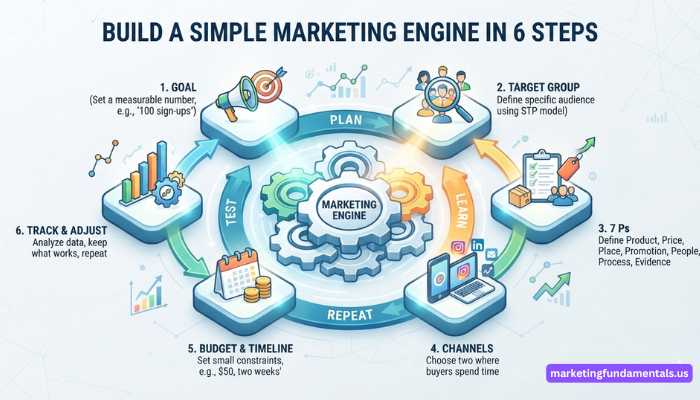
Reading about theory is one thing. Here’s how to put it to work today.
- Write down your goal. Pick one clear number, like “get 100 new sign-ups this month.”
- Pick your target group. Use the STP model above. Be specific.
- Check your 7 Ps. Fill in each one for your product, even in one short sentence.
- Choose two channels. Don’t spread thin. Pick where your buyers already spend time.
- Set a small budget and timeline. Even $50 and two weeks is enough to test an idea.
- Track results and adjust. Look at what worked. Drop what didn’t. Repeat.
This loop, plan, test, learn, repeat, is the real engine behind every strong marketing team.
Marketing Channels: Which One Fits Your Brand?
| Channel | Best For | Cost to Start |
|---|---|---|
| Social media | Building awareness fast | Low |
| Keeping past buyers close | Low | |
| Content/blog (SEO) | Long-term, steady traffic | Low to medium |
| Paid ads | Quick results, testing offers | Medium to high |
| Events/in-person | Trust and big-ticket sales | High |
| Traditional (TV, print) | Wide, broad reach | High |
Small businesses often start with social media and email. They’re cheap, fast, and easy to measure.
Common Marketing Mistakes to Avoid
Even smart teams fall into these traps.
- Trying to reach everyone. A message for all is a message for no one. Narrow your focus.
- Skipping the “why.” Listing features without saying why they matter to the buyer.
- Ignoring the data. Running the same ad for months without checking if it works.
- No follow-up plan. Winning a customer once, then never emailing or checking in again.
- Copying competitors blindly. What works for a big brand may not fit your budget or buyers.
How to Measure Marketing Success?
You can’t improve what you don’t track. Here are the numbers that matter most, especially when you’re just starting out.
| Metric | What It Tells You |
|---|---|
| Website traffic | How many people see your brand |
| Conversion rate | What share of visitors actually buy |
| Cost per lead | How much you spend to get one interested buyer |
| Customer retention rate | How many buyers come back |
| Return on ad spend (ROAS) | How much money you earn per dollar spent on ads |
Start small. Pick two or three metrics. Check them weekly. Don’t drown in data you won’t use.
Staying Current With Marketing Trends
Marketing fundamentals stay steady. But the tools and habits around them shift fast. A few forces that shape change:
- Shifting age groups. Each new generation responds to different styles and platforms.
- New tech. Voice search, AI tools, and mobile-first habits change how people find you.
- Market swings. What people can afford today may change fast.
- Culture and values. Buyers increasingly choose brands that match their values.
The best way to stay sharp is simple: read often, test small, and watch your own data closely. Trends matter less than knowing your own buyers well.
Books Worth Reading for Marketing Basics
If you want to go deeper, these four books are a strong start:
- “This Is Marketing” by Seth Godin – A short, clear case for marketing to the smallest group that truly cares, instead of chasing everyone.
- “Good to Great” by Jim Collins – Not a marketing book alone, but a study of what separates strong companies from average ones.
- “Building a StoryBrand” by Donald Miller – Shows how to explain your product using simple story structure so customers instantly get it.
- “Content: The Atomic Particle of Marketing” by Rebecca Lieb – Covers why content, not ads alone, has become the core of most marketing plans.
Frequently Asked Questions
What are the basics of marketing fundamentals? The basics are the 7 Ps: product, price, promotion, place, people, process, and physical evidence. Together they cover what you sell, how much it costs, how people hear about it, and how they buy it.
What is the difference between marketing and advertising? Advertising is one part of marketing. It’s the paid promotion piece. Marketing covers the full picture: your product, price, place, and more.
Do small businesses need all 7 Ps? Yes. Even a one-person shop should think through each P. You don’t need a big budget. You just need clear answers for each one.
What is the STP model in marketing? STP stands for segmentation, targeting, and positioning. It helps you find the right group of buyers before you spend money reaching them.
How much should a small business spend on marketing? Many small firms spend around 5% to 10% of revenue on marketing. Start smaller if you’re new, then grow your budget as you see results.
What is the most important marketing fundamental? Knowing your buyer. Every other choice, price, channel, message, depends on truly understanding who you’re trying to reach.
How long does it take to see marketing results? Paid ads can show results in days. Content and SEO often take three to six months to build steady traffic. Be patient with slower channels.
Final Thoughts
Marketing doesn’t need to feel like a mystery. Learn who your buyer is. Answer the 7 Ps clearly. Guide people through the funnel step by step. Track what works. Drop what doesn’t.
Do this well, and you won’t just market a product. You’ll build a brand people trust and come back to.