








Marketing is not magic. It is a skill you can learn, practice, and get better at over time. But a lot of people skip the fundamentals and jump straight into tactics. They run ads before they understand their audience. They post on social media before they know what they want to say. They measure the wrong things and wonder why nothing works.
This guide fixes that. You will walk away with a clear understanding of what marketing actually is, how it works, and what you need to do to build a strategy that gets results.
What Marketing Actually Means
Marketing is the process of connecting what you offer with the people who need it. That is the whole thing. Everything else, the ads, the content, the campaigns, is just how you execute that connection.
Good marketing does three things. It finds the right audience. It delivers the right message. It shows up at the right time. When all three align, marketing works. When one is off, nothing else makes up for it.
A lot of businesses treat marketing as a department or a budget line. Successful businesses treat it as a mindset that touches every part of the company, from how you answer the phone to how you write a product description.
The Four Pillars of Marketing
You have probably heard of the 4 Ps. They date back to the 1960s and they still hold up because they describe the actual decisions every marketer has to make.
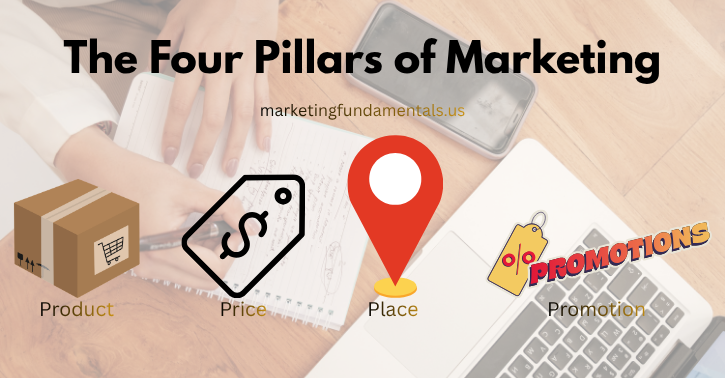
Product is what you sell. This includes what it does, how it is packaged, what makes it different from alternatives, and what problem it solves. Your product is the foundation of your marketing. If the product does not work, marketing cannot save it. It will only accelerate failure.
Price is what you charge. Price sends a signal to your market. A high price says “this is premium.” A low price says “this is accessible.” Neither is wrong. Both need to match what your audience expects and what your brand promises. Pricing also affects your margins, which affects how much you can spend on marketing in the first place.
Place is where people buy. That might be a physical store, your website, Amazon, a third-party retailer, or all of the above. Distribution matters more than most people think. A great product at a great price fails if customers cannot find it or access it easily.
Promotion is how you communicate. This is what most people think of when they hear “marketing.” It includes advertising, content, social media, email, public relations, and anything else you use to reach your audience and convince them to buy.
These four pillars work together. Change one and it affects the others. Raise your price without improving your product and customers notice. Expand your distribution without adjusting your promotion and you create confusion. Think of them as a system, not separate decisions.
Understanding Your Target Audience
This is where most marketing goes wrong. People describe their target audience as “everyone” or “people aged 18 to 65 who like our product.” That is not an audience. That is a wish.
A real target audience is specific. It has demographics like age, location, income, and education. It also has psychographics like values, fears, goals, and habits. You need both.
Here is a practical way to build an audience profile. Think about your best current customers. What do they have in common? Why do they choose you over alternatives? What problem were they trying to solve when they found you? What almost stopped them from buying?
Talk to actual customers if you can. The language they use to describe their problems is often the exact language you should use in your marketing. This is not a shortcut. This is one of the most valuable things you can do.
Once you understand your audience, every other marketing decision gets easier. You know what channels they use. You know what messages will land. You know what objections to address before they even ask.
The Customer Journey
People do not wake up and immediately buy something. They go through a process. Marketing calls this the customer journey, and understanding it changes how you build your strategy.
The journey has four stages.
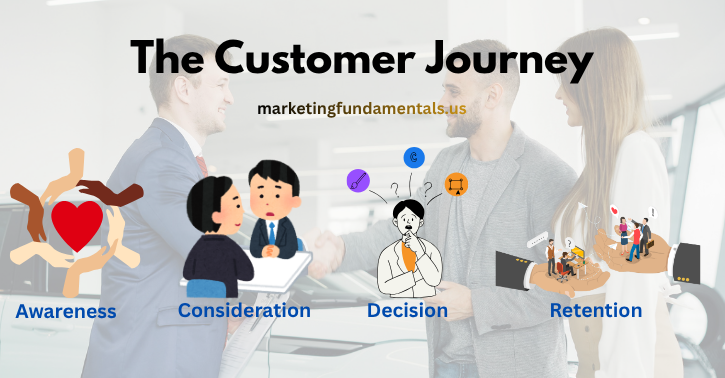
Awareness is when someone first learns you exist. They may have seen an ad, heard a recommendation, or stumbled across your content. At this stage, they are not ready to buy. They are just becoming aware of a problem or a possible solution.
Consideration is when they start comparing options. They know the problem and they are looking at different ways to solve it, including your product and your competitors. Your job here is to give them the information they need to make a decision and to make a strong case for why you are the right choice.
Decision is when they buy. This is where the final barriers need to come down. Clear pricing, easy checkout, strong guarantees, and social proof all help here.
Retention is what happens after the sale. Most businesses underinvest here. Keeping a customer costs far less than finding a new one. A retained customer also buys again, refers others, and leaves reviews. Retention is where real business value compounds.
Your marketing should address all four stages. If you only focus on awareness, you get traffic that does not convert. If you only focus on decision, you never fill your pipeline. Map your content, campaigns, and touchpoints to each stage.
Brand Positioning
Positioning answers one question. Why should someone choose you instead of the alternatives?
If you cannot answer that clearly, your marketing will always feel vague. You will say things like “quality products” and “excellent service” because those are safe defaults. But they do not actually say anything. Every competitor claims the same thing.
Good positioning is specific and defensible. It says what you do, who you do it for, and why that matters more than what anyone else offers.
To find your positioning, look at three things. What do you do better than competitors? What do your best customers actually value? Where do those two things overlap? That overlap is your positioning.
Once you have it, your positioning should show up everywhere. In your tagline, your homepage copy, your sales pitch, and your ads. Consistency is what makes positioning stick in the minds of your audience.
Marketing Channels
A marketing channel is any platform or method you use to reach your audience. There are many. You do not need all of them. You need the ones your audience actually uses.
Search Engine Optimization (SEO) helps you show up when people search for what you offer. It takes time to build but pays off long term. If someone searches for a problem your product solves, appearing at the top of those results is enormously valuable.
Paid Advertising lets you reach specific audiences quickly. Google Ads, Meta Ads, and LinkedIn Ads all let you target by demographics, interests, and behaviors. Paid channels are great for testing messages and scaling what works, but they require ongoing spend.
Content Marketing builds trust by sharing useful information. Blog posts, videos, guides, and podcasts all fall here. Content works best when it helps your audience solve a real problem. If it does that, it also builds credibility and drives organic traffic over time.
Email Marketing remains one of the highest return channels available. An email list is an asset you own. When someone gives you their email address, they are giving you direct access to their attention. Use that access well by sending genuinely useful content, not just promotions.
Social Media works when you understand which platform your audience uses and what they expect there. A B2B company may find LinkedIn more effective than Instagram. A consumer brand may find the reverse. Choose channels based on where your audience is, not where you are comfortable.
Referrals and Word of Mouth are often underestimated. A recommendation from a trusted person carries more weight than any ad. You can build referral programs into your business intentionally. More importantly, delivering a product and experience worth talking about generates referrals naturally.
Setting Marketing Goals
Marketing without goals is just spending money. You need to know what you are trying to achieve before you decide how to achieve it.
Good marketing goals follow a clear pattern. They are specific, measurable, and tied to a time frame. “Get more customers” is not a goal. “Acquire 200 new customers in Q3 at a cost of under $50 each” is a goal.
Different goals require different strategies. If you want to increase brand awareness, you focus on reach and impressions. If you want to generate leads, you focus on conversion rates and cost per lead. If you want to retain customers, you focus on engagement and repeat purchase rates.
Write your goals down before you build your plan. Then make sure every tactic you choose connects back to one of those goals. If it does not, cut it.
Measuring Marketing Performance
What you measure determines what you improve. Track the wrong things and you optimize for the wrong outcomes.
The most common measurement mistake is focusing on vanity metrics. Followers, likes, and page views feel like progress but they do not pay the bills. Revenue, conversions, and customer acquisition cost are the numbers that matter.
Here are the metrics worth tracking.
Conversion Rate tells you what percentage of visitors, leads, or prospects take the action you want. A higher conversion rate means your message is landing and your offer is compelling.
Customer Acquisition Cost (CAC) tells you how much you spend to get each new customer. Compare this to how much each customer is worth over their lifetime with you. If CAC is higher than lifetime value, the business model does not work.
Return on Ad Spend (ROAS) tells you how much revenue you generate for every dollar you put into advertising. A ROAS of 3x means you earn $3 for every $1 spent.
Email Open and Click Rates tell you whether your email content is relevant and your subject lines are working.
Customer Lifetime Value (CLV) tells you how much a customer is worth over the entire relationship. Businesses with high CLV can afford to spend more to acquire customers and still be profitable.
Track these consistently. Review them monthly. Act on what they tell you.
Building a Simple Marketing Plan
You do not need a 50-page document. You need a clear, usable plan that guides your decisions.
A simple marketing plan covers six things.
First, define your audience. Who are you trying to reach and what do they care about?
Second, clarify your positioning. What makes you different and why does that matter to your audience?
Third, set your goals. What specific outcomes do you want to achieve and by when?
Fourth, choose your channels. Based on your audience and goals, which platforms and methods will you use?
Fifth, create your content and campaigns. What will you actually say and do across those channels?
Sixth, measure and adjust. How will you know if it is working, and what will you change if it is not?
Review your plan every quarter. Markets change, audiences shift, and what worked six months ago may need updating.
Common Marketing Mistakes to Avoid
These mistakes show up constantly, even in experienced marketing teams.
Skipping the research. Assumptions about your audience are dangerous. Get real data from real customers before you build a campaign.
Chasing trends. A new platform or format grabs attention. Not every trend belongs in your strategy. Ask whether your audience is actually there before you invest time.
Inconsistent messaging. Your website says one thing, your ads say another, and your sales team says a third. Inconsistency confuses people and erodes trust.
Giving up too soon. Most marketing takes time to work. SEO takes months. Content builds audiences gradually. Paid ads need testing cycles. Impatience kills results.
Not testing. The best marketers test constantly. Try two subject lines and see which performs better. Test two ad headlines. Run two landing page versions. Small improvements compound.
Frequently Asked Questions
What are the most basic marketing fundamentals every business needs?
Every business needs a clear target audience, a defined value proposition, at least one channel to reach customers, and a way to measure results. Without these four things, the rest is guesswork.
How do I know which marketing channel to focus on?
Start by figuring out where your audience spends time and how they make buying decisions. A B2B service may find email and LinkedIn most effective. A direct-to-consumer brand may see better results from Instagram and paid search. Test, measure, and put your budget where results show up.
How long does marketing take to show results?
It depends on the channel. Paid advertising can produce results within days. SEO typically takes three to six months. Content marketing and brand building can take a year or more to pay off meaningfully. Set realistic timelines based on the channels you choose.
What is the difference between marketing and advertising?
Advertising is one part of marketing. Marketing covers the full strategy of how you position, price, distribute, and promote your product. Advertising is specifically the paid promotion part of that strategy.
How much should a business spend on marketing?
There is no universal answer. A common benchmark is 5 to 10 percent of revenue for established businesses and higher for businesses in growth mode. The right number depends on your goals, your margins, and how competitive your market is.
What is content marketing and does it actually work?
Content marketing means creating useful material like articles, videos, or guides that help your audience solve a problem. It works because it builds trust and attracts people who are already interested in what you offer. It takes longer than paid advertising to show results, but the leads it generates tend to be higher quality and the traffic continues without ongoing spend.
How do I write a marketing strategy from scratch?
Start with your audience. Then define your positioning. Set specific goals. Choose two or three channels based on where your audience is. Create a 90-day content and campaign plan. Measure results and adjust. You do not need a complicated framework. You need a clear starting point and a commitment to reviewing what is working.