
You want to know one thing fast: how big is the Security Service Edge market, and how fast is it growing? Here it is in plain words.
The global SSE market was worth $6.08 billion in 2024. It should reach $23.01 billion by 2030. That is a CAGR of 24.8% over six years. In short, the market will grow nearly four times over.
This guide breaks down what that growth means, who is driving it, and what you should do with this data. No jargon. No fluff. Just clear facts.
What Is Security Service Edge (SSE)?
SSE is a cloud-based security model. It protects users when they access the web, cloud apps, and private apps. It does not matter where the user sits or what device they use.
SSE bundles four main tools into one system:
- Zero Trust Network Access (ZTNA) – checks every user before granting access
- Secure Web Gateway (SWG) – filters unsafe web traffic
- Cloud Access Security Broker (CASB) – controls how staff use cloud apps
- Firewall as a Service (FWaaS) – blocks threats at the network edge
Think of SSE as a security guard that travels with your data. It does not sit at one office door anymore. It follows the user, the laptop, and the app, wherever they go.
Security Service Edge Market Size and Growth: The 2024 Numbers
Here is the core data point behind this whole topic.
| Year | Market Size (USD) |
|---|---|
| 2024 (base year) | $6.08 billion |
| 2030 (forecast year) | $23.01 billion |
| CAGR (2024–2030) | 24.8% |
That 24.8% CAGR is a strong number. Most tech markets grow at 10% to 15% a year. SSE is growing almost twice as fast. This tells you buyers are moving fast from old, on-site security tools to cloud-based ones.
Why This Growth Rate Matters to You
If you sell into this space, a 24.8% CAGR means the market will nearly double every three years. If you buy SSE tools, it means more vendors, more features, and more price competition are coming your way soon.
Key Drivers Behind SSE Market Growth
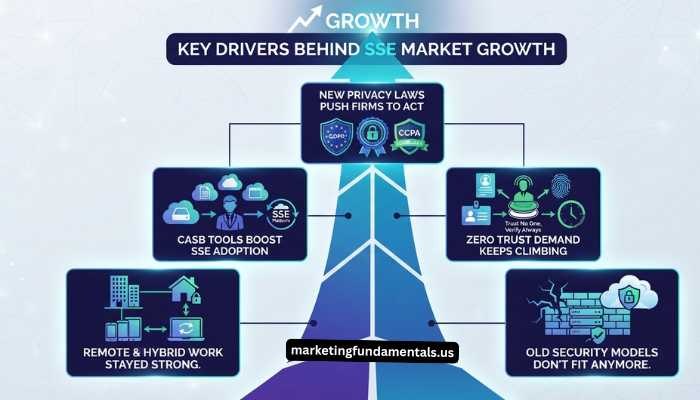
Five main forces push this market up.
1. Remote and hybrid work stayed strong. Fewer firms now force full-time office attendance. Staff need safe access from home, cafes, and airports. Old office firewalls cannot do this job well.
2. Old security models don’t fit anymore. Perimeter-based security assumed everyone worked inside one building. That idea is broken now. Teams need one security layer that follows the user, not the building.
3. CASB tools boost SSE adoption. Firms that add Cloud Access Security Broker tools to their stack tend to move to full SSE platforms next. It’s a natural next step.
4. Zero trust demand keeps climbing. Zero trust checks every user and device each time, not just once at login. This model fits well with SSE’s design.
5. New privacy laws push firms to act. Rules like GDPR and CCPA force firms to protect data better. SSE helps firms meet these rules while keeping staff productive.
What’s Holding the Market Back?
No market grows without friction. Two issues slow SSE adoption down.
Old systems don’t mix well with new ones. Many firms still run old, on-site tools. Moving to SSE means rebuilding security rules from scratch. This takes time, money, and skilled staff.
Skilled staff are hard to find. SSE needs trained security teams. Many firms just don’t have enough of them yet. This slows rollout speed.
The Big Opportunity: AI and Machine Learning
Here’s where the market gets exciting. AI and ML tools, when paired with SSE, can:
- Spot strange user behavior in real time
- Catch new attacks before they spread
- Cut false security alerts
- Auto-fix small security issues without a human
Vendors like Palo Alto Networks, Fortinet, and Skyhigh Security already sell AI-based SSE tools. Expect this trend to grow fast through 2030.
SSE Market Breakdown by Segment
The table below shows how the market splits by type.
| Segment | Fastest-Growing Sub-Segment | Why |
|---|---|---|
| Offering | Solutions | Firms want an all-in-one tool, not many separate ones |
| Solution Type | Firewall-as-a-Service | Cloud firms need strong, scalable edge defense |
| Service Type | Managed SSE Services | Firms lack in-house staff to run SSE alone |
| Organization Size | SMEs | Small firms want low-cost, flexible, cloud-based tools |
| Deployment | Cloud | Lower upfront cost, easy to scale up or down |
| Vertical | BFSI (Banking) | Banks hold sensitive data and face strict rules |
SSE Market by Region
North America leads the pack. It has strong tech infrastructure, strict rules like CCPA, and top vendors based there, such as Zscaler, Palo Alto Networks, and Cloudflare.
| Region | Growth Driver |
|---|---|
| North America | Strong tech base, top vendors, strict data laws |
| Europe | GDPR rules push firms to adopt cloud security fast |
| Asia Pacific | Fast digital growth, more cloud use, new gov rules |
| Middle East & Africa | More firms go mobile, more cyber risk awareness |
| Latin America | New privacy laws like Brazil’s LGPD boost demand |
Canada is the fastest-growing market inside North America. Asia Pacific overall is tipped to post the highest regional CAGR through 2030, as firms there race to catch up on cloud security.
Top Players in the SSE Market
A short list of the biggest names shaping this space:
- Zscaler
- Cisco
- Palo Alto Networks
- Netskope
- Fortinet
- Cloudflare
- Broadcom
- Check Point (Perimeter 81)
- Skyhigh Security
- HPE Aruba Networks
Most top players are US firms. That is why North America keeps the largest market share.
Read: Lottery Game Developers Market Analysis 2026: Full Guide + Data
SSE vs. SASE vs. Zero Trust: What’s the Real Difference?
This part often confuses buyers. Here is the simple version.
| Term | What It Covers | Best For |
|---|---|---|
| SSE | Cloud security only (ZTNA, SWG, CASB, FWaaS) | Firms that already own good network tools and just need better security |
| SASE | SSE + networking (like SD-WAN) | Firms that want to fix both network speed and security at once |
| Zero Trust | A security rule, not a full product | Any firm, as a mindset behind SSE or SASE tools |
In plain words: Zero trust is the idea. SSE is a toolset that follows that idea for cloud security. SASE is SSE plus network routing tools bundled together.
How to Choose the Right SSE Vendor?
Buying SSE is a big decision. Use these six checks before you sign a deal.
- Does it cover all four core tools? ZTNA, SWG, CASB, and FWaaS should work as one system, not four separate logins.
- Can it scale with your team size? Ask how it performs at 10x your current staff count.
- Does it slow down your apps? Ask for a live test with your own video calls and cloud tools.
- Does it use AI for threat detection? This cuts down false alerts and speeds up fixes.
- What does support look like? Some vendors sell managed SSE services. This helps if your team is small.
- How does pricing scale? Ask for per-user cost at your current size and at 2x growth.
How MarketsandMarkets’ Forecast Compares to Other Firms?
Different research firms give different numbers. Here’s a side-by-side view so you don’t rely on just one source.
| Research Firm | 2024 Market Size | Forecast Year | Forecast Size | CAGR |
|---|---|---|---|---|
| MarketsandMarkets | $6.08B | 2030 | $23.01B | 24.8% |
| Grand View Research | $6.26B | 2033 | $36.87B | 21.9% |
| SNS Insider | $6.17B | 2032 | $33.27B | 23.4% |
| Research Nester | $6.58B (2025) | 2035 | $58.87B | 24.5%+ |
The base-year numbers sit close together, near $6 billion. The CAGR range runs from about 22% to 25% across firms. That tight range is a good sign. It means the growth story is real, not just one firm’s guess.
Final Takeaway
The Security Service Edge market sits at a turning point. It was worth $6.08 billion in 2024. It could hit $23.01 billion by 2030. That’s a 24.8% CAGR, one of the strongest growth rates in the whole cybersecurity space.
Remote work, zero trust demand, and new privacy laws all push this market forward. AI and ML will likely push it even further past 2030. If you work in cybersecurity, cloud IT, or tech investing, this is a market worth watching closely over the next five years.
Frequently Asked Questions
What is the Security Service Edge (SSE) market size in 2024? The global SSE market was worth $6.08 billion in 2024, according to MarketsandMarkets.
What is the CAGR of the SSE market from 2024 to 2030? The market is set to grow at a CAGR of 24.8% during this period.
How big will the SSE market be by 2030? It should reach $23.01 billion by 2030.
What is the difference between SSE and SASE? SSE covers cloud security tools only. SASE adds network tools like SD-WAN on top of SSE. SASE is the bigger, combined package.
Which region leads the SSE market? North America leads, thanks to strong tech infrastructure and top vendors based there.
Which industry uses SSE the most? BFSI (banking, financial services, and insurance) leads, due to strict data rules and high fraud risk.
Who are the top SSE vendors? Zscaler, Cisco, Palo Alto Networks, Netskope, Fortinet, and Cloudflare are among the top names in this space.
Is SSE the same as zero trust? No. Zero trust is a security idea. SSE is a toolset built around that idea. You can have zero trust rules without full SSE, but most modern SSE tools use zero trust as their base rule.
Why is the SSE market growing so fast? Remote work, weak old security models, new privacy laws, and rising zero trust demand all push growth. AI tools are adding even more fuel to this growth.
Do small businesses need SSE too? Yes. In fact, SMEs are the fastest-growing buyer group. Cloud-based SSE tools cost less upfront and scale well, which fits small teams with tight budgets.